
How to Get Monroe Court Records
Open Indiana MyCase first. Jot down the case number and the caption. Add the event date and the document name before you do anything else. If the event shows an available image, read it right there. When no image appears, that does not mean the filing never happened. The Monroe Clerk records page links to the public search and to an online request vendor. The vendor form can return a 403 response, so treat it as unreliable.
- Search MyCase and identify the exact Monroe County case.
- Note the dated event and requested document or judgment.
- Try the document link when public download is allowed.
- Call 812-349-2614 or visit the Clerk counter if it is missing.
- For mail, confirm cost and return instructions before sending funds.
Prefer mail? Address it to Monroe County Clerk, PO Box 547, Bloomington, IN 47402. State the case number, caption, event date, copy type, and your contact details. Add any prepaid return method the Clerk directs. Indiana's court-record request instructions make one point plain: when a record is not online, the court or Clerk that holds it is the fallback. Phone, counter, and mail are core channels for a docket lookup. They are not last resorts.
Monroe Clerk Counter Route
The Monroe County Clerk of Court keeps the records for all nine Circuit Court divisions. The public counter sits in Suite 201. Its address is 301 N College Ave, Bloomington, IN 47404. Hours run Monday through Friday, 8:00 a.m. to 4:00 p.m., except holidays. Call 812-349-2614 with questions. One office covers criminal, civil, family, probate, juvenile, small-claims, eviction, infraction, ordinance, and protective-order records. Access restrictions vary by file, though.
Monroe County Clerk of Court
301 N College Ave, Suite 201
Bloomington, IN 47404
812-349-2614
Mail: PO Box 547, Bloomington, IN 47402
Original files never leave court control. Local Rules LR53-AR00-0128 and 0131 bar public removal from the Clerk's Office and removal from the Justice Building without judicial permission. Staff may supervise in-person review as a result. Bring the case number and a clear description of what you need.
Types of Monroe Court Records
Keep three layers separate in your mind. The public Chronological Case Summary is a dated index of events. Behind one event sits a filed document. That could be a complaint, motion, order, judgment, summons, or exhibit. A certified copy is different still, because the Clerk authenticates it for formal use. A printed MyCase page never becomes certified just because it came from an official portal.
| Record layer | What it gives | Best access route |
|---|---|---|
| Chronological Case Summary | Dates, status, events, settings, and links | MyCase or Clerk |
| Filed document | The actual pleading, order, notice, or judgment | Public download when allowed; otherwise Clerk |
| Certified copy | Clerk-authenticated record | Request from the Monroe Clerk |
| Transcript | Written court proceeding | The division’s court reporter |
| Audio | Copy governed by local recording rule | Written party-of-record request |
Authentication, exemplification, certification, plain copies, transcripts, and audio are not interchangeable. Ask for the specific copy type by name rather than "the record."
Monroe Document Download Labels
A MyCase document object can show its name, page count, download permission, and a link. Labels such as PageCount and CanDown describe the online object. They do not guarantee that every reader can retrieve the file. Public, party, and attorney access can expose different sets of images.
- PageCount
- The number of pages recorded for the document object.
- CanDown
- An access flag tied to download permission in the current view.
- Chronological Case Summary
- The dated register of events, not the full document set.
- Certified copy
- A copy authenticated by the Monroe County Clerk.
If the docket lists an order but no image opens, write down the event date and description. Those details let Clerk staff find the document without a vague name-only search.
What Monroe Court Records Contain
The header of a public court record may show the Monroe division, case number, filing date, case type, caption, and status. It may also show a public-access flag. Party and attorney roles can follow. The chronology may list pleadings, appearances, service, notices, motions, orders, settings, disposition, and financial events. Criminal and infraction files can go further. They may display charges, statute references, citation numbers, and an Appear By Date.
| Header | Court, case number, filing date, case type, caption, and status. |
|---|---|
| Parties and counsel | Procedural roles, attorney names, and bar data when public. |
| Chronology | Dated filings, clerk acts, settings, orders, and closure. |
| Document object | Name, page count, and download access when available. |
| Financial data | Charges, transactions, balances, and an as-of date where shown. |
| Cross references | Related, transferred, or companion matters when populated. |
A case summary can contain omissions and an old balance. The official record stays with the court and Clerk.
Monroe Transcript and Audio Routes
Transcripts come from the court reporter, not the Clerk's copy counter. Local Rule LR53-AR00-0132 sets $6 per page for county or state indigent work. It sets $6.50 for private non-appellate work. A copy of a prepared transcript costs $3.50. Expedited private rates run $10, $9, and $8 per page for 7-, 14-, and 23-day service. Confirm scope and estimate with the reporter first. Audio falls under LR53-AR00-0129. A party of record may make a written request and supply blank media. The party copy then comes at no cost under that rule. Recordings from before 2012 go through the Office of Court Services. Records from 2012 forward go through the court reporter. Note that public status in MyCase alone does not make you a party of record.
Certified Monroe Copies and Fees
The official public sources post no Monroe-specific plain-copy, certification, or search fee. Do not borrow another county's price. Before sending any money, ask the Clerk for the amount. Ask about the accepted payment method, certification needed, mailing charge, and return instructions too. Indiana's statewide manual lists filing and cost components. But those are not a Monroe copy quote. The Indiana trial court fee manual publishes the statewide fee schedules.
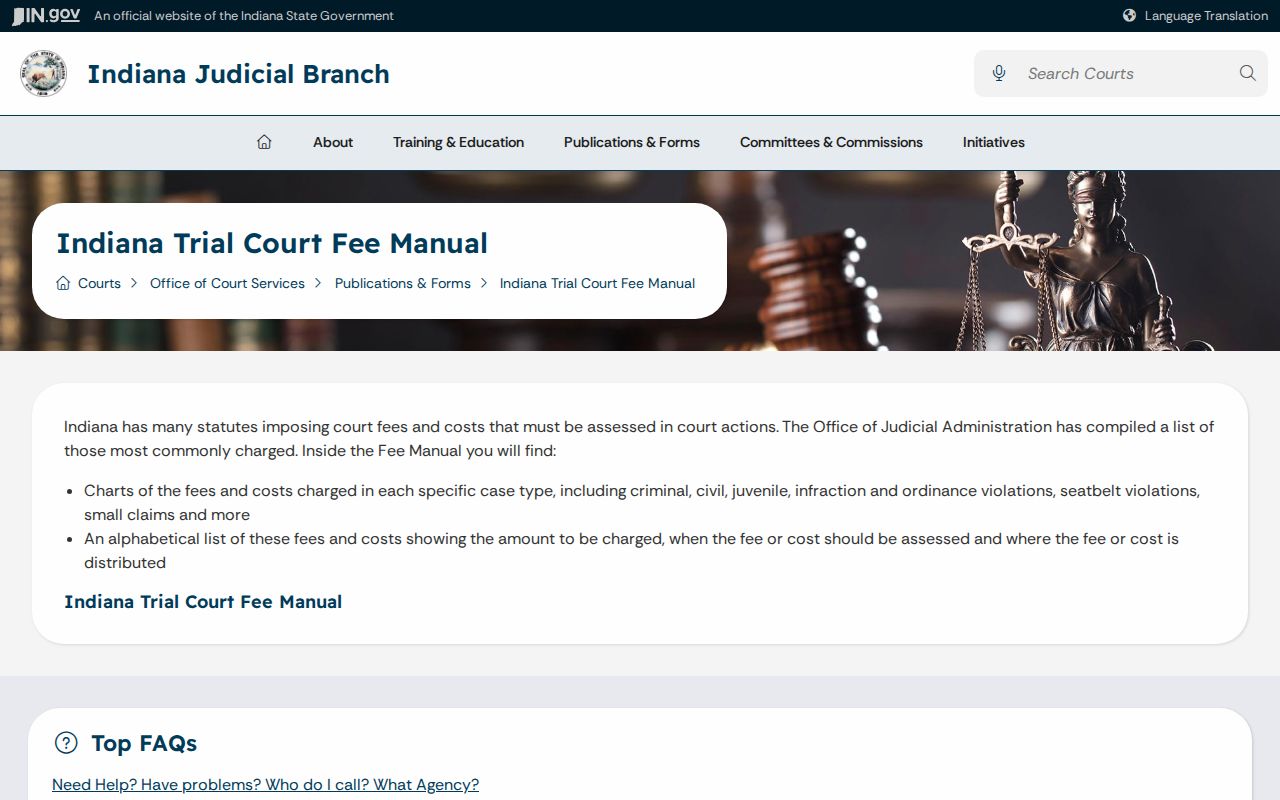
The manual cites items like $70 in infraction or ordinance costs and $5 document storage. Those case-cost components are not per-page copy fees.
| Request | Supported Monroe status |
|---|---|
| Plain copy | Available through Clerk; current local amount not published in located sources. |
| Certified copy | Request from Clerk; confirm certification fee. |
| Search fee | No separate current Monroe amount located. |
| Transcript | Local reporter rates apply. |
| Party audio | No cost under local rule; requester supplies media. |
Accessible Monroe Record Requests
Monroe County lists reasonable accommodations, effective-communication aids, sign-language interpreters, Braille, auxiliary audio or visual aids, and policy modifications. Anyone who needs an accommodation for courthouse record access should use the county's official ADA route and give enough notice for coordination. See the Monroe County ADA page for the county's own accommodation policy.
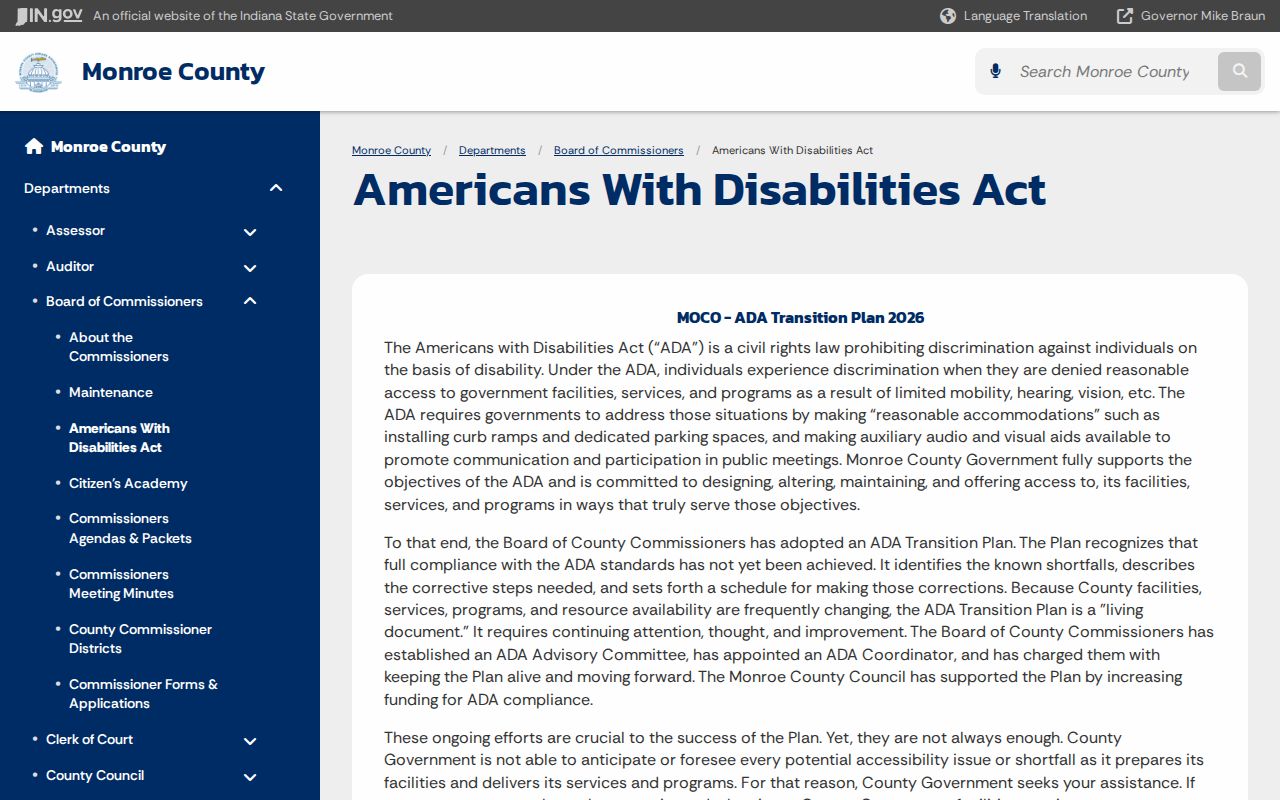
The county has not fully met every accessibility goal yet. So check the specifics first. Ask the ADA coordinator what aid, route, and timing you need before you rely on any file format or counter feature being ready.
Public and Sealed Monroe Records
Indiana Access Rule 4 opens the courthouse doors: most case records start out public. Rule 5 then draws the lines. It excludes or restricts juvenile and mental-health cases, sealed material, and protected identifiers. Privileged content is restricted too, along with anything a law or court order makes nonpublic. Even a public-access copy may arrive with data redacted. Meanwhile the court quietly keeps a fuller nonpublic version under seal.
Restricted access: Access Rule 9 may require a verified request, notice, a showing of extraordinary public interest, and a court order. A routine Clerk request cannot bypass the rule.
Indiana sets the baseline with the Access to Public Records Act, IC 5-14-3. That law covers public records generally. Judicial records answer to a separate set of court-specific Access Rules. An older or missing file? Call the Clerk or visit the courthouse to inspect it in person. For bulk or compiled court data, route the request through the Office of Court Services.
Monroe Request Form Access Gap
The Monroe County Clerk's records page points to an outside request form. But that vendor page answers with a 403 error. So it blocks ordinary visitors. The fields, upload rules, identification needs, payment options, and turnaround times it lists stay hidden from public view. Skip the guesswork. Use the Clerk's phone, counter, or mail route for your court records request instead. Name the case number, the event date, the document, and the copy type you want. Ask the price and the return method before you send payment to Monroe County.